
You’re standing in the pharmacy aisle, or scrolling an app store at 11pm, trying to solve the same worry either way. Mom keeps missing doses. Do you buy the plastic weekly box, or set up a reminder app on her phone?
Here’s the thing worth knowing before you spend a cent. You’re not really choosing between a box and an app. You’re choosing what happens on the morning a dose gets missed anyway. And on that question, the two tools are far more alike than the reviews admit.
Let’s compare them honestly, side by side. Then let’s talk about the gap that neither one closes on its own, because that gap is usually the real reason you’re worried.
Key Takeaways
- Across developed countries, only about 50% of long-term medication for chronic illness is taken as prescribed (WHO, 2003). Neither tool fixes that alone.
- A pill organizer shows what’s left in the box. A reminder app fires an alert. Only one job each, and both stop at “we hope it was taken.”
- Apps assume a phone-comfortable parent. In Poland as of 2024, only about 12.6% of people aged 65–74 had basic-or-above digital skills (GUS, via review 2024).
- The tool matters less than the match. Pick for your parent’s memory and schedule, and make sure a missed dose reaches a human early.
What’s the real difference between a pill organizer and a reminder app?
A pill organizer sorts the week’s medication into labelled compartments so a dose is pre-counted and visible. A reminder app lives on a phone and sends an alert when it’s time. One organizes the pills. The other announces the moment. That’s the whole split, and it explains why each solves only half the problem.
Why does the split matter so much? Because roughly half of long-term medication goes untaken in the first place. In 2003, the World Health Organization put it plainly in its report Adherence to Long-Term Therapies: in developed countries, only about 50% of medication for chronic illness is taken as prescribed (WHO, 2003). Poor adherence is one of the most common and costly problems in modern care. In a 2018 OECD working paper on medication adherence, the cost to Europe was estimated at around €125 billion a year (OECD, 2018).
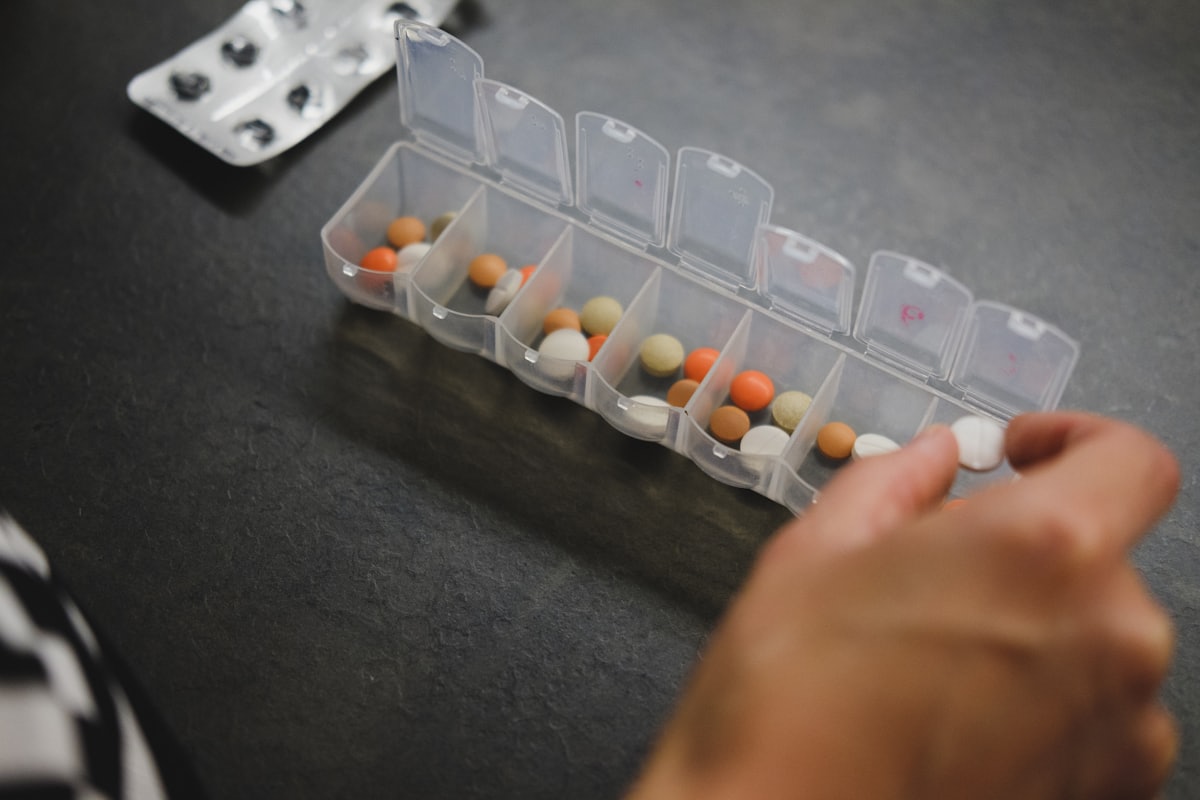
So a box and an app are two different answers to one question: how do we help this dose actually happen? Keep that question in view. It’s the fair way to judge either one.
Does a weekly pill organizer actually work?
Yes, while it’s used, and that caveat matters. A weekly organizer turns a vague “did you take it?” into a quick visual check: full Monday slot, missed Monday dose. It’s cheap, needs no charging, and works for a parent who wants nothing to do with a screen. For many families, it’s the sensible first move.
But two honest limits show up fast. First, an organizer confirms only that a compartment is empty, not that the pill was swallowed. A dose can be tipped into a hand, set on the counter, and forgotten, or quietly refused. Second, the benefit leans on the routine holding. A box helps most while it’s part of a daily habit, and its pull fades if that habit slips. An organizer is a scaffold, not a cure.
There’s a quieter catch, too. The fuller the medication list, the more a weekly box strains. And these lists are long. As of 2018, about 32% of EU adults aged 65 and older took five or more medications, based on the SHARE survey of ageing (Midão et al., 2018). In Poland as of 2019, it was higher still, around 42% of people aged 65 and older, rising past half among those in their eighties (Kardas et al., 2021). Eight medicines across four timings turn a tidy grid into a puzzle.
So how does a weekly organizer stack up against the other two options families reach for?
| Weekly pill organizer | Reminder app | Automatic dispenser | |
|---|---|---|---|
| Upfront cost | Very low (a few euros) | Free to low | Higher (device, often a subscription) |
| Tech required | None | A smartphone, and comfort using it | Setup, sometimes WiFi |
| Best suited to | Simple to moderate schedules | A sharp, phone-comfortable parent | Complex schedules, higher-risk misses |
| Confirms a dose was taken? | Only by counting later | No, an alarm only fires | Some log or lock each dose |
| Can family see a miss? | Only in person | Rarely, on its own | Some alert a caregiver |
| Handles 5+ meds, many timings | Gets crowded | Yes, but more alerts to dismiss | Yes |
Notice the two rows that repeat across the first two columns: confirms a dose and can family see a miss. That’s the pattern worth holding onto.
Are reminder apps better for an 80-year-old?
Sometimes, and it depends almost entirely on the parent, not the app. Reminder apps do genuinely help. A 2020 review in the Journal of Managed Care & Specialty Pharmacy found that mobile-app reminders significantly improved adherence versus usual care in adults with chronic conditions (JMCP, 2020). An app also travels. The phone is in a pocket at the shops or a friend’s house, where a countertop box is stuck at home.

But an app carries the pill organizer’s core weakness and adds one of its own. A notification only fires. It’s silenced by a thumb on autopilot, and it leaves no trace of whether anything happened next. Worse, it assumes a parent who’s at ease with a smartphone, and that assumption is shakier than the app store suggests.
The encouraging half: older adults are far more online than the stereotype. As of 2024, roughly 80% of EU adults aged 65 to 74 used the internet, up from about 20% in 2009, per Eurostat (Eurostat, 2024).
Being online, though, isn’t the same as being able to run a medication app. That distinction is where families get caught. In Poland as of 2024, only about 12.6% of people aged 65 to 74 had basic-or-above digital skills, per figures from the national statistics office GUS (GUS, via peer-reviewed review, 2024). Checking the weather is one thing. Reliably dismissing the right alert, at the right time, for the right pill, every single day, is another. For a parent in that gap, an app can quietly add stress instead of removing it.
The question neither tool answers on its own
Here’s the part the comparison charts skip. A pill organizer and a reminder app are both open-loop. The box shows an empty slot. The app shows a fired alarm. Neither one can tell you the single thing you actually lie awake wondering: did the dose really happen, and would anyone know if it didn’t?
This is the confirmation gap, and it’s the true source of most caregiver worry. A missed dose stays invisible until something goes wrong, days or weeks later. Nobody sees the gap in real time, so nobody can gently step in. That’s why swapping a box for an app, or an app for a box, so often changes nothing. You’ve moved the tool. You haven’t closed the loop.
According to the WHO’s landmark review, about half of long-term medication for chronic disease goes untaken in developed countries (WHO, 2003). A tool that only nudges or only sorts will always leave that half partly unaddressed, because the missing ingredient isn’t a better reminder. It’s visibility — a way for a missed dose to reach someone who can respond.
For the fuller version of this idea, see our piece on why a reminder is never the hard part.
How to choose: match the tool to your parent, not the review
The honest answer to “which is better” is “which fits the person.” The best tool is the one your parent will actually use, matched to their memory and the length of their list. Run through this quickly, and you’ll usually know within a minute.
- Sharp mind, short list, comfortable with a phone? A reminder app tied to a daily routine is often plenty. Keep it simple.
- Wants nothing to do with screens? A weekly pill organizer, anchored to breakfast or the evening news, is the kinder choice. Don’t force an app to win a debate it was never in.
- Long or complex schedule, or a few misses already? Lean toward a locking automatic dispenser, or pair a box with a person who checks. Emerging evidence supports in-home dispensers for older adults with chronic conditions (pilot RCT, 2021).
- Memory genuinely slipping? No tool replaces a human handing the pills over. As of 2025, more than 9 million people across the EU live with dementia (Alzheimer Europe, 2025), and self-managed systems have real limits here.
- Whatever you pick, add one channel that makes a miss visible. A sibling who calls, a pill case you photograph on visits, a dispenser that texts you, or an app that confirms a dose was taken. That’s the piece that turns any tool into peace of mind.

Building the habit around the tool matters more than the tool itself. If you’re starting from scratch, our guide to building a calm medication routine with an aging parent walks through the anchoring step in detail.
Frequently Asked Questions
Is a pill organizer or a reminder app better for an elderly parent?
Neither wins on its own. Pick for your parent: an app suits a phone-comfortable, cognitively sharp parent; a weekly organizer suits someone who avoids screens. Then add a way to see a missed dose early, since about 50% of long-term medication goes untaken without one (WHO, 2003).
Do medication reminder apps actually work for older adults?
They can. A 2020 review found app reminders significantly improved adherence versus usual care in adults with chronic conditions (JMCP, 2020). The catch is fit: an app assumes phone comfort, and in Poland only about 12.6% of people aged 65–74 had basic digital skills as of 2024 (GUS, 2024).
What are the downsides of a weekly pill organizer?
Two main ones. It shows an empty compartment but can’t confirm the pill was actually swallowed, and its benefit tends to fade once the routine slips. It also gets crowded for long lists, and around 32% of EU adults aged 65+ take five or more medications (Midão et al., 2018).
Should I get an automatic pill dispenser instead?
Consider one for complex schedules or when misses have already happened. Locking dispensers release the correct dose and some alert a caregiver, and early trials support their use for older adults with chronic conditions (pilot RCT, 2021). For a simple schedule and a sharp mind, it’s usually overkill. Ask a pharmacist about blister packs too.
The choice that actually matters
Step back from the box-versus-app debate and the picture gets simpler. Both tools do useful, partial work. Both leave the same gap: they can’t tell you a dose truly happened, and they can’t reach you when one is missed. So choose the tool that fits your parent’s day, then add the one thing the tool can’t provide on its own, visibility.
You don’t need to get this perfect. You need one system your parent will keep, and one way to see a miss before it becomes a pattern. Start there, and the low background hum of worry gets quieter fast. If a calm reminder for them and a quiet confirmation for you sounds like the missing piece, that’s exactly what Carely is built to do, and the person you care for can use it free.
Related: your parent says they took their pills, but the case says otherwise.
Sources
- World Health Organization, Adherence to Long-Term Therapies: Evidence for Action (news release and report), 2003. Retrieved 2026-07-21. https://www.who.int/news/item/01-07-2003-failure-to-take-prescribed-medicine-for-chronic-diseases-is-a-massive-world-wide-problem
- Midão et al., Polypharmacy prevalence among older adults based on the Survey of Health, Ageing and Retirement in Europe (SHARE), Archives of Gerontology and Geriatrics, 2018. Retrieved 2026-07-21. https://www.sciencedirect.com/science/article/abs/pii/S0167494318301328
- Kardas et al., Prevalence and Age Structure of Polypharmacy in Poland, Frontiers in Pharmacology, 2021 (PMC8082447; 2019 reimbursement data). Retrieved 2026-07-21. https://pmc.ncbi.nlm.nih.gov/articles/PMC8082447/
- OECD, Investing in Medication Adherence Improves Health Outcomes and Health System Efficiency (Health Working Paper No. 105), 2018. Retrieved 2026-07-21. https://www.oecd.org/en/publications/investing-in-medication-adherence-improves-health-outcomes-and-health-system-efficiency_8178962c-en.html
- Effectiveness of Mobile Applications on Medication Adherence in Adults with Chronic Disease (systematic review and meta-analysis), Journal of Managed Care & Specialty Pharmacy, 2020. Retrieved 2026-07-21. https://www.jmcp.org/doi/10.18553/jmcp.2020.26.4.550
- Medication adherence support of an in-home electronic medication dispensing system (pilot randomized controlled trial), 2021 (PubMed 33446126). Retrieved 2026-07-21. https://pubmed.ncbi.nlm.nih.gov/33446126/
- Eurostat, People online in 2024 / Digital society statistics, 2024. Retrieved 2026-07-21. https://ec.europa.eu/eurostat/web/products-eurostat-news/w/ddn-20241217-1
- Główny Urząd Statystyczny (GUS), Information Society digital-skills data, reported via peer-reviewed review, 2024. Retrieved 2026-07-21. https://www.tandfonline.com/doi/full/10.1080/03601277.2024.2439908
- Alzheimer Europe, The Prevalence of Dementia in Europe 2025, 2025. Retrieved 2026-07-21. https://www.alzheimer-europe.org/resources/publications/prevalence-dementia-europe-2025